

Table of Contents
Helical piles are steel deep foundation elements installed by rotating a shaft with one or more helical bearing plates into the ground. Also called screw piles, helical piers, or helical pile foundations, they are used where shallow foundations cannot provide adequate bearing, settlement control, uplift resistance, or constructability. A helical pile system is not just a steel product. It is a designed foundation assembly that includes the pile shaft, helical plates, couplings, extension sections, termination hardware, installation equipment, torque monitoring, load verification, corrosion protection, and inspection documentation. When properly designed and installed, helical piles provide a practical foundation solution for residential, commercial, industrial, utility, marine, boardwalk, retrofit, and limited-access construction.
What Helical Piles Are
A Screwed-In Deep Foundation
A helical pile is a displacement foundation installed by applying torque to a steel shaft until the lead section and helix plates reach the design bearing stratum. Unlike driven piles, helical piles are not hammered into the ground. Unlike drilled shafts, they do not require excavation, casing, or concrete placement in the ground. The pile advances because the helical plates act like screw threads, pulling the shaft downward as torque is applied.
The term “helical pile” is commonly used for compression foundations, while “helical anchor” is often used for tension or tieback applications. In practice, the same general technology may be used for compression, tension, or lateral-load systems, provided the product, connection details, installation angle, embedment, and load path are designed for the specific condition.
Helical piles are most valuable where foundations need to be installed quickly, with limited vibration, limited spoils, relatively small equipment, and immediate loading capability. They are frequently used where access is restricted, where vibration-sensitive structures are nearby, where groundwater complicates excavation, or where variable soils make shallow foundations risky.
Helical Piles, Screw Piles, and Helical Piers
The names helical piles, screw piles, and helical piers are often used interchangeably, but the wording can imply different markets. “Screw pile” is an older and still widely used term that describes the installation method. “Helical pier” is common in residential repair and underpinning. “Helical pile” is the more common engineering and commercial construction term.
The important point is that all of these terms refer to a steel foundation element with one or more helical plates that transfers load to soil through bearing, shaft resistance, or a combination of mechanisms depending on soil profile, pile geometry, and loading direction.
How Helical Piles Work
Load Transfer Through Helical Plates
The primary axial capacity of a helical pile is typically associated with bearing at the helix plates. When a pile is loaded in compression, the plates transfer force into competent soil below the foundation. When loaded in tension, the plates resist uplift by mobilizing soil above the helices. The exact resistance mechanism depends on helix spacing, soil type, embedment depth, plate diameter, and whether individual bearing or cylindrical shear behavior governs.
For many conventional helical pile layouts, designers evaluate the bearing contribution of each helix plate. Where helices are spaced far enough apart, the plates may act more independently. Where helices are closer together, the soil between plates may behave more like a cylinder moving with the pile. This distinction matters because it affects capacity calculations and the interpretation of load tests.
Capacity Related to Installation Torque
One of the defining features of helical pile systems is that installation torque provides useful field feedback. In general, higher torque indicates stronger resistance during installation, and this has long been used as a practical correlation to estimate axial capacity. The commonly referenced relationship is that ultimate capacity is correlated with final installation torque multiplied by a torque correlation factor. However, torque is not a substitute for engineering judgment, soil investigation, product limitations, or load testing where required.
The torque correlation factor is not universal. It depends on shaft type, shaft size, helix configuration, installation conditions, and loading direction. Research published through the Deep Foundations Institute notes that capacity-to-torque behavior depends on more than shaft geometry, including helix configuration, axial load direction, and installation torque. That is why responsible specifications do not treat torque as a magic number. They define equipment requirements, torque measurement methods, minimum embedment, termination criteria, product ratings, and proof or verification testing where appropriate.
Immediate Load Support
Helical piles can generally be loaded immediately after installation because they do not rely on concrete curing. This is a major advantage for fast-track work, emergency repairs, temporary works, utility foundations, boardwalks, modular construction, and retrofit projects where schedule control is critical.
Immediate loading does not mean design can be skipped. The pile must still be advanced to the required depth and torque, the shaft and connection must have adequate structural capacity, and installation records must demonstrate that the specified criteria were met.
Main Components of a Helical Pile System
Lead Section
The lead section is the first part of the pile installed into the ground. It includes the pile shaft and one or more welded helical plates. The lead section determines the initial penetration behavior and is critical to the final capacity of the pile.
Lead sections may use round shaft, square shaft, or pipe shaft configurations. Square shafts are common in tension and underpinning applications where torsional strength and penetration through dense soils are important. Round shaft and pipe shaft piles are commonly used in compression applications, particularly where buckling, lateral stiffness, and structural capacity are major considerations.
Helical Plates
Helical plates are circular or near-circular steel plates formed into a helix and welded to the pile shaft. They are designed to advance through the soil with limited disturbance while providing bearing capacity after installation. Plate diameter, thickness, pitch, spacing, and weld quality all affect performance.
The number and size of helices are selected based on required capacity, soil strength, installation feasibility, and the torque capacity of the pile shaft. Larger plates can provide more bearing area, but they also require more torque to install and may not penetrate dense soils as easily. More helices can increase capacity, but they also increase installation resistance and must be properly spaced to perform as intended.
Shaft
The shaft transfers load from the structure to the helices and must resist axial force, bending, buckling, torsion during installation, and connection forces. Shaft selection is one of the most important design decisions in a helical pile system.
Small square shafts may be efficient for tension and retrofit work, but compression piles in soft soils often require careful evaluation of buckling. Pipe shafts offer greater section properties and can provide better compression and lateral performance. The designer must consider not only geotechnical capacity, but also structural capacity of the steel section above and below grade.
Extensions and Couplings
Most helical piles are installed in segments. After the lead section is advanced, extension sections are added until the pile reaches the required depth and torque. Couplings connect the segments and transfer axial, torsional, and bending forces through the pile.
Couplings are not incidental hardware. They are part of the structural load path. Poorly detailed couplings can reduce pile stiffness, limit bending capacity, or introduce weak points during installation. Project specifications should require compatible manufacturer components and documented capacities for shafts, couplings, bolts, and termination brackets.
Termination Brackets and Caps
The termination connects the installed pile to the supported structure. New construction may use pile caps, concrete grade beams, pile caps cast around the pile head, or steel brackets. Retrofit underpinning may use side-load brackets attached to existing footings. Utility and equipment foundations may use bolted caps or grillage connections.
The termination detail must match the load path. A compression pile under a new grade beam is not the same as an underpinning pier attached to the side of an existing footing. Eccentricity, bracket rotation, concrete condition, reinforcement, edge distance, and load transfer into the structure must all be addressed.
Typical Helical Pile System Components
|
Component |
Function |
Key Design Consideration |
|---|---|---|
|
Lead Section |
Starts installation and carries the helix plates |
Helix size, number, pitch, and shaft type |
|
Helical Plates |
Transfer load into bearing soil |
Soil strength, spacing, diameter, and embedment |
|
Shaft |
Transfers compression, tension, torsion, and bending |
Structural capacity, buckling, corrosion, and installation torque |
|
Extensions |
Add length to reach bearing depth |
Coupling strength and alignment |
|
Couplings |
Connect pile segments |
Axial, torsional, and bending capacity |
|
Termination Hardware |
Connects pile to the structure |
Load path, eccentricity, and constructability |
|
Corrosion Protection |
Extends service life in aggressive environments |
Soil corrosivity, coatings, galvanizing, and sacrificial thickness |
|
Installation Equipment |
Applies torque and crowd force |
Torque capacity, access, calibration, and monitoring |
|
Load Testing |
Verifies performance where required |
Test method, acceptance criteria, and documentation |
Design Capacity of Helical Piles
Geotechnical Capacity
Geotechnical capacity is the resistance provided by the soil. For axial compression, this usually includes bearing below the helices and may include shaft resistance depending on design assumptions. For tension, resistance is mobilized above the helices and along the pile-soil interface where applicable.
A complete geotechnical design starts with subsurface information. Soil borings, test pits, cone penetration testing, local experience, groundwater observations, and laboratory testing may all be relevant. Without soil information, pile selection becomes guesswork. Experienced installers can provide useful practical insight, but final design should be based on a project-specific evaluation by qualified professionals.
The designer must identify suitable bearing strata, weak layers, fill, organics, soft clay, loose sand, debris, collapsible soils, expansive soils, frost depth, groundwater, scour potential, and obstructions. Helical piles can handle many difficult soil conditions, but they are not suitable for every profile. Cobbles, boulders, dense gravel, shallow rock, debris fill, and very hard layers can prevent proper installation or damage the pile.
Structural Capacity
Structural capacity is the strength of the steel pile system itself. A helical pile may have adequate soil capacity but still be limited by shaft strength, coupling capacity, bracket capacity, buckling, or torsional limits during installation. This is especially important for compression piles in soft soils, piles with long unsupported lengths, battered piles, high lateral loads, and marine or flood-prone installations.
Designers must check axial compression, axial tension, bending, combined loading, buckling, connection strength, and installation torque limits. The maximum allowable installation torque of the pile system cannot be exceeded. A pile that is over-torqued during installation may be structurally compromised even if the field log shows high resistance.
Allowable and Ultimate Capacity
Helical pile capacity is often discussed in terms of ultimate capacity and allowable capacity. Ultimate capacity is the estimated or tested maximum resistance before failure criteria are reached. Allowable capacity is the service-level capacity after applying a factor of safety. In strength design formats, resistance factors may be applied instead.
The factor of safety or resistance factor depends on the design code, load testing program, redundancy, site variability, risk level, and governing limit state. A pile supporting a lightly loaded deck does not carry the same consequence as a pile supporting a commercial building column, a bridge approach, or an industrial vessel foundation.
Installation Process
Preconstruction Planning
A successful installation starts before the rig arrives. The contractor should review plans, geotechnical information, pile schedule, required capacities, termination details, access constraints, overhead clearances, underground utilities, spoil tolerance, nearby structures, and inspection requirements.
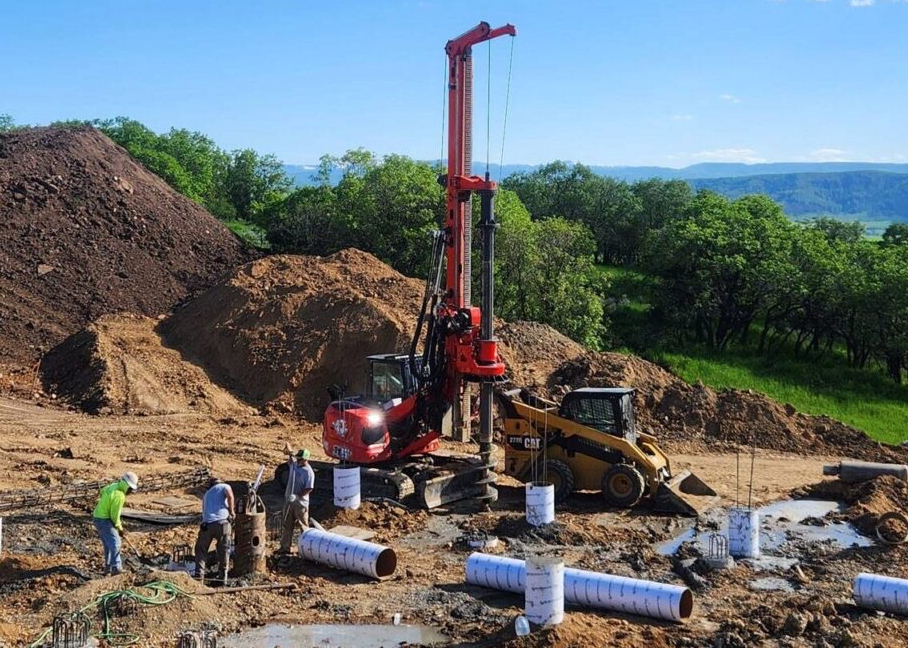
Helical piles are often selected because access is limited, but limited access still requires planning. Equipment must be able to reach the work area, maintain alignment, apply the required torque, and install the pile to the required depth. Mini-excavators, skid steers, track loaders, excavators, mast-mounted rigs, and hand-held equipment all have practical limits. The drive head must have enough torque capacity, and the carrier must provide enough crowd force and stability.
Pile Layout and Positioning
Pile locations should be surveyed or laid out from approved drawings. Alignment is important because eccentricity can reduce performance and complicate connection details. Vertical piles must be installed within specified plumb tolerances. Batter piles and tieback anchors must be installed at the correct inclination and orientation.
For underpinning, excavation around existing footings must be controlled to avoid undermining the structure. For new construction, pile heads must be placed accurately enough to connect to grade beams, caps, or structural steel without field modifications that compromise the design.
Torque Monitoring
During installation, torque is monitored to evaluate resistance and determine whether termination criteria are being met. Torque may be measured through hydraulic pressure correlation, differential pressure devices, calibrated drive heads, or inline torque transducers. The measurement method should be specified and suitable for the project.
Hydraulic pressure alone is not the same as true torque unless it is correlated to the specific drive head and equipment. Drive head efficiency, hydraulic system condition, pressure losses, and motor characteristics can affect readings. For critical work, better torque measurement and calibration practices reduce uncertainty.
Depth and Termination Criteria
A helical pile should not be accepted based on torque alone if it has not reached the required minimum depth or embedment. Similarly, reaching depth without torque may indicate the pile has not found adequate bearing. Typical termination criteria include minimum depth, minimum final installation torque, bearing stratum confirmation, pile head elevation, and refusal or obstruction procedures.
If a pile reaches refusal too shallow, the contractor and engineer must determine whether the pile can be accepted, relocated, predrilled, replaced with a different configuration, or supplemented. If a pile fails to achieve torque at the expected depth, additional extensions may be required. These decisions should be documented rather than handled casually in the field.
Soil Conditions and Suitability
Good Soil Conditions for Helical Piles
Helical piles perform well in many sands, silts, clays, and mixed soil profiles where the helices can be advanced to a competent bearing layer. They are especially useful where soft near-surface soils overlie stronger material at depth. In those conditions, shallow footings may settle excessively while helical piles can transfer load deeper into the profile.
They are also useful in wet sites, high groundwater areas, environmentally sensitive locations, and retrofit projects where excavation spoils must be minimized. Because installation is rotary and displacement-based, helical piles can reduce spoil handling compared with drilled foundations.
Difficult Soil Conditions
Helical piles can be difficult or impractical in soils containing large cobbles, boulders, construction debris, rubble, very dense gravel, or shallow rock. These materials can deflect the pile, damage helices, prevent advancement, or cause false torque readings. Dense layers may require predrilling, specialized tooling, smaller lead sections, or alternate foundation systems.
Very soft soils can also be challenging, especially for compression piles with slender shafts. The pile may need to extend deeper to reach competent material, and the shaft may require buckling checks. Organic soils and uncontrolled fill require particular caution because they may not provide reliable long-term support.
Groundwater, Scour, and Frost
Groundwater does not usually prevent helical pile installation, but it affects corrosion, soil strength, excavation safety, and construction logistics. In marine or waterfront work, scour can remove supporting soil around the pile and reduce lateral or axial resistance. In cold regions, frost depth matters for pile embedment, grade beam detailing, and uplift forces.
Helical piles used for decks, boardwalks, solar arrays, utilities, and light structures must still be designed for frost and seasonal ground movement. Small structures are not exempt from soil mechanics.
Code Compliance and Evaluation Reports
AC358 and IBC Recognition
In the United States, helical pile systems are commonly evaluated through ICC-ES Acceptance Criteria AC358 for helical foundation systems and devices. AC358 establishes requirements used for recognition in ICC-ES evaluation reports under the International Building Code. These reports typically address allowable loads, material requirements, installation requirements, inspection requirements, and conditions of use for specific proprietary systems.
Code compliance is not achieved simply by using a product that has an evaluation report. The project must still satisfy the conditions of that report, the applicable building code, the geotechnical recommendations, the structural design, and the approved construction documents. Installers and inspectors need to verify that the installed pile matches the specified system, shaft size, helix configuration, torque requirements, depth requirements, and connection details.
Engineering Responsibility
Helical piles are proprietary systems, but they still require project-specific engineering. Manufacturer tables can help with preliminary selection, but they do not replace a foundation design. The engineer of record, geotechnical engineer, specialty engineer, contractor, and manufacturer may all have roles, depending on the project delivery method.
Clear responsibility matters. Someone must determine design loads, load combinations, geotechnical parameters, corrosion exposure, minimum pile length, pile spacing, group effects, lateral requirements, structural connections, testing requirements, and acceptance criteria. The best helical pile projects define these responsibilities before installation begins.
Load Testing and Verification
Why Load Testing Matters
Load testing verifies that installed piles perform as expected under controlled loading. It is especially important on large projects, high-load applications, variable sites, unfamiliar soil profiles, new pile configurations, and projects where torque correlation alone is not enough.
A load test can confirm axial compression capacity, axial tension capacity, or lateral resistance depending on the test setup. Results can be used to validate design assumptions, refine production pile criteria, or identify problems before the full installation is complete.
Proof Tests and Verification Tests
Proof testing is commonly used to confirm production pile performance to a specified test load. Verification testing is often performed before or early in production to establish that the selected pile configuration can achieve the required capacity at the site. The test method, load increments, hold times, deflection limits, and acceptance criteria should be defined in the specifications.
Testing should be interpreted by qualified personnel. Pile movement under load is not automatically failure. Acceptance depends on the project criteria, load level, movement behavior, rebound, creep, and applicable standards or specifications.
Applications of Helical Pile Foundations
Residential Foundations and Underpinning
Helical piers are widely used for residential foundation repair, additions, porches, decks, crawlspace supports, and new homes on poor soils. In underpinning, brackets are installed at existing footings and loads are transferred to deeper bearing strata. This can stabilize settlement where shallow foundations are bearing on weak or variable soils.
Residential work requires care because existing foundations may be cracked, lightly reinforced, shallow, or irregular. The bracket-to-footing connection is often the limiting detail, not the pile itself. Contractors must evaluate concrete condition, footing geometry, utilities, access, and jacking procedures before assuming that a standard repair detail is suitable.
Commercial and Industrial Foundations
Commercial helical pile foundations are used for column loads, grade beams, mezzanines, equipment pads, pipe racks, tanks, signs, canopies, modular buildings, and temporary structures. They are attractive when speed, low vibration, and limited spoils are important.
Industrial projects often introduce higher loads, lateral forces, dynamic effects, chemical exposure, and strict documentation requirements. In these environments, helical pile systems must be designed and installed with the same discipline expected for any deep foundation system.
Boardwalks, Walkways, and Light Civil Structures
Helical piles are common for boardwalks, pedestrian bridges, observation platforms, park structures, and wetland access projects. Small equipment can reduce disturbance in environmentally sensitive areas. Immediate load capacity can shorten construction schedules and limit temporary works.
These projects often involve soft soils, high water tables, flood exposure, and corrosion risk. Designers should account for lateral loads, uplift, scour, durability, and constructability rather than treating boardwalk piles as simple deck supports.
Solar, Utility, and Infrastructure Work
Helical piles and ground screws are used for solar arrays, utility poles, communications equipment, lighting, signage, and small infrastructure foundations. Installation speed and repeatability are major advantages on sites with many similar supports.
For solar and utility work, uplift, cyclic wind loading, corrosion, installation tolerances, and production quality control are critical. A small error repeated hundreds or thousands of times can become a major performance issue.
Marine, Seawall, and Flood-Prone Sites
Helical piles can be used in waterfront and flood-prone environments for docks, seawalls, bulkheads, elevated structures, and foundation retrofits. Their low-vibration installation can be useful near existing structures and sensitive shorelines.
Marine use requires careful corrosion design, scour evaluation, lateral analysis, and constructability planning. Saltwater, fluctuating groundwater, oxygen exposure, and abrasion can shorten service life if corrosion protection is not properly specified.
Advantages of Helical Pile Systems
Low Vibration and Limited Spoils
One of the biggest advantages of helical piles is low-vibration installation. This makes them useful near existing buildings, utilities, historic structures, occupied facilities, and vibration-sensitive equipment. Because they are displacement piles, they also generate little to no excavation spoil compared with drilled shafts or augered piles.
This advantage can reduce hauling, cleanup, site disturbance, and environmental impacts. On urban and retrofit sites, it can also reduce disruption to occupants and neighboring properties.
Fast Installation and Immediate Loading
Helical piles can often be installed quickly with relatively compact equipment. Since there is no concrete curing period for the below-grade element, construction can proceed immediately after installation and inspection. For repair work, this can shorten downtime. For new construction, it can compress the foundation schedule.
Fast installation should not be confused with casual installation. Production speed is only an advantage when pile logs, torque records, alignment, depth, and termination criteria are properly controlled.
Useful in Restricted Access
Helical piles are often chosen where larger foundation equipment cannot operate. Interior retrofits, basements, crawlspaces, alleys, backyards, steep sites, wetlands, and congested urban projects may all benefit from smaller installation equipment.
Restricted access can also limit torque capacity and pile size. The selected equipment must still be able to install the specified pile. If the only machine that fits cannot produce the required torque, the design and installation plan must be revised.
Limitations and Risks
Obstructions and Refusal
Subsurface obstructions are one of the most common risks. Boulders, debris, old foundations, timber, rubble, and dense fill can stop or deflect piles. A helical pile that refuses too shallow may not have adequate embedment or capacity.
Good specifications include procedures for obstruction handling. These may include relocation, predrilling, removal of obstruction, alternate pile configuration, or engineering review. Field crews should not simply cut piles off and move on without approval.
Buckling and Slender Shaft Concerns
Compression piles with slender shafts installed through soft soils require buckling evaluation. The surrounding soil can provide lateral support, but very soft or weak soils may not provide enough restraint. Unsupported lengths above grade, scour zones, liquefiable layers, and voids also require attention.
Buckling is a structural limit state. It is not solved by achieving installation torque. A pile can develop torque at depth and still be structurally inadequate if the shaft is too slender for the unsupported or weakly supported length.
Lateral Load Limitations
Helical piles can resist lateral loads, but lateral performance is often controlled by near-surface soil and shaft stiffness rather than helix bearing at depth. Slender piles in soft near-surface soils may have limited lateral capacity unless designed with larger shafts, battered piles, pile groups, grade beams, or other lateral systems.
Contractors and owners should be cautious when expecting a single small-diameter helical pier to resist large lateral loads. Lateral design requires soil parameters, deflection criteria, and structural analysis.
Corrosion and Service Life
Helical piles are steel foundations, so corrosion must be evaluated. Soil resistivity, pH, chlorides, sulfates, moisture, oxygen, stray currents, fill materials, and marine exposure can all affect durability. Protection methods may include hot-dip galvanizing, coatings, sacrificial steel thickness, cathodic protection, or product selection based on exposure.
Corrosion design should match the intended service life. Temporary works, residential decks, commercial buildings, and marine structures do not all require the same durability strategy.
Cost Factors for Helical Pile Foundations
What Drives Cost
The cost of a helical pile system depends on pile size, pile length, helix configuration, required capacity, soil conditions, corrosion protection, site access, equipment requirements, testing, engineering, and connection details. Mobilization can be a major factor on small projects, while production rate and pile quantity drive cost on larger projects.
Difficult access may increase labor even if the piles are small. Dense soils may require heavier equipment or stronger pile sections. Soft soils may require longer piles. Corrosive sites may require galvanizing or other protection. High-load commercial work may require larger shafts, load testing, specialty brackets, and more documentation.
Why Unit Prices Can Mislead
A simple per-pile price can be misleading because it may exclude engineering, layout, excavation, brackets, caps, testing, spoils, access preparation, inspection, and remediation for obstructions. Two piles with the same diameter can have very different installed costs if one is 10 feet long in clean sand and the other is 45 feet long through fill and soft clay.
Owners should compare complete installed scope, not just pile material. Contractors should clarify assumptions about minimum length, refusal, testing, bracket details, and downtime.
Inspection and Documentation
Installation Records
Installation logs are essential. A proper log should identify pile location, shaft size, lead configuration, extension lengths, final depth, installation torque, pile head elevation, installation angle, equipment used, installer, date, and any unusual conditions.
For commercial projects, logs should be reviewed against the approved pile schedule and acceptance criteria. Missing documentation can create problems during inspection, closeout, financing, or future modifications.
Special Inspection
Depending on the code jurisdiction, structure type, and project documents, helical pile installation may require special inspection. Inspectors may verify product identification, equipment, torque monitoring, pile location, alignment, depth, installation torque, coupling installation, bracket installation, and load testing.
Inspection should not be treated as paperwork after the fact. It is part of quality control during installation. The inspector needs access to the work, the approved documents, and the acceptance criteria.
Helical pile systems are practical, fast, and technically capable deep foundations when they are designed and installed correctly. Their advantages are clear: low vibration, limited spoils, compact equipment, immediate loading, and strong performance in many poor-soil and retrofit conditions. Their limitations are just as important: obstructions, buckling, lateral loads, corrosion, torque measurement uncertainty, and the need for project-specific design.
A reliable helical pile foundation is not created by simply screwing steel into the ground until the machine works hard. It is created by matching the pile system to the structure, the soil, the load path, the code requirements, the installation equipment, and the inspection plan. When those pieces are coordinated, helical piles can provide an efficient foundation solution for residential, commercial, industrial, infrastructure, marine, and limited-access construction.